
Mulai sekarang kamiialah Elev8
Kami lebih daripada sekadar broker. Kami adalah ekosistem dagangan serba ada—semua yang anda perlukan untuk menganalisis, berdagang, dan berkembang ada di satu tempat. Sedia untuk tingkatkan dagangan anda?
Kami lebih daripada sekadar broker. Kami adalah ekosistem dagangan serba ada—semua yang anda perlukan untuk menganalisis, berdagang, dan berkembang ada di satu tempat. Sedia untuk tingkatkan dagangan anda?
The Australian Dollar (AUD) edges lower against the US Dollar (USD) on Wednesday following the release of weaker-than-expected domestic economic data. However, the AUD/USD pair gained ground as the US Dollar (USD) remains subdued amid rising odds of the Federal Reserve (Fed) cutting interest rates.
The Australian Bureau of Statistics (ABS) showed that Retail Sales rose 0.2% month-over-month in May, compared to a flat 0% in April (revised from -0.1%). The reading came in below the market expectations of 0.4%.
Additionally, the AUD/USD pair appreciated due to improved market sentiment, driven by the news that the US President Donald Trump’s top trade officials were seeking phased tariff deals with the most engaged countries as they pushed on to reach an agreement by the July 9 deadline, when Trump had vowed to reimpose his harshest levies, per the Financial Times.
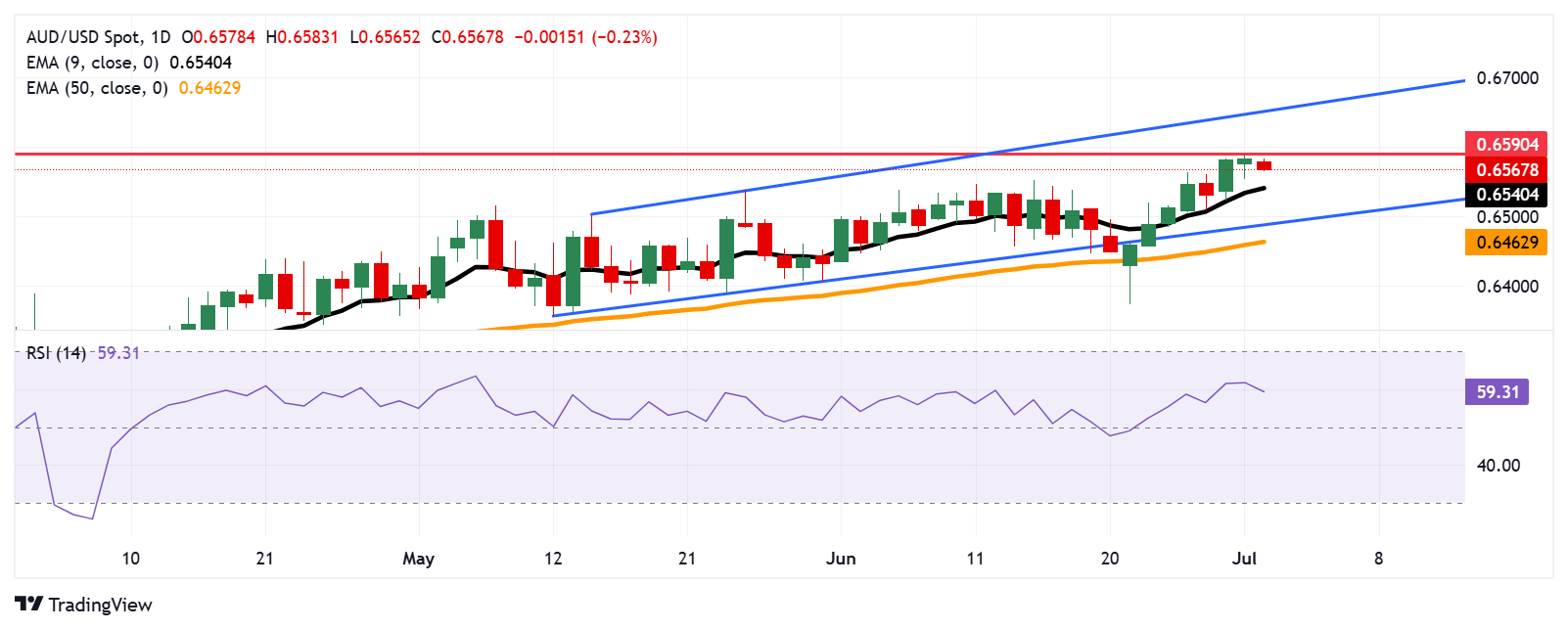
The AUD/USD pair is trading around 0.6570 on Wednesday. The daily technical analysis indicates a persistent bullish bias as the pair remains within the ascending channel pattern. The 14-day Relative Strength Index (RSI) is positioned above the 50 mark. Additionally, the pair rises above the nine-day Exponential Moving Average (EMA), indicating that short-term price momentum is stronger.
On the upside, the AUD/USD pair could rebound to the fresh eight-month high of 0.6590, which was recorded on July 1, followed by the upper boundary of the ascending channel around 0.6650.
The nine-day EMA at 0.6540 appears as the primary support. A break below this level would weaken the short-term price momentum and put downward pressure on the AUD/USD pair to test the lower boundary of the ascending channel around 0.6490, aligned with the 50-day EMA at 0.6462.
The Retail Sales data, released by the Australian Bureau of Statistics on a monthly basis, measures the value of goods sold by retailers in Australia. Changes in Retail Sales are widely followed as an indicator of consumer spending. Percent changes reflect the rate of changes in such sales, with the MoM reading comparing sales values in the reference month with the previous month. Generally, a high reading is seen as bullish for the Australian Dollar (AUD), while a low reading is seen as bearish.
Read more.Last release: Wed Jul 02, 2025 01:30
Frequency: Monthly
Actual: 0.2%
Consensus: 0.4%
Previous: -0.1%
Source: Australian Bureau of Statistics
The primary gauge of Australia’s consumer spending, the Retail Sales, is released by the Australian Bureau of Statistics (ABS) about 35 days after the month ends. It accounts for approximately 80% of total retail turnover in the country and, therefore, has a significant bearing on inflation and GDP. This leading indicator has a direct correlation with inflation and the growth prospects, impacting the Reserve Bank of Australia’s (RBA) interest rates decision and AUD valuation. The stats bureau uses the forward factor method, ensuring that the seasonal factors are not distorted by COVID-19 impacts.